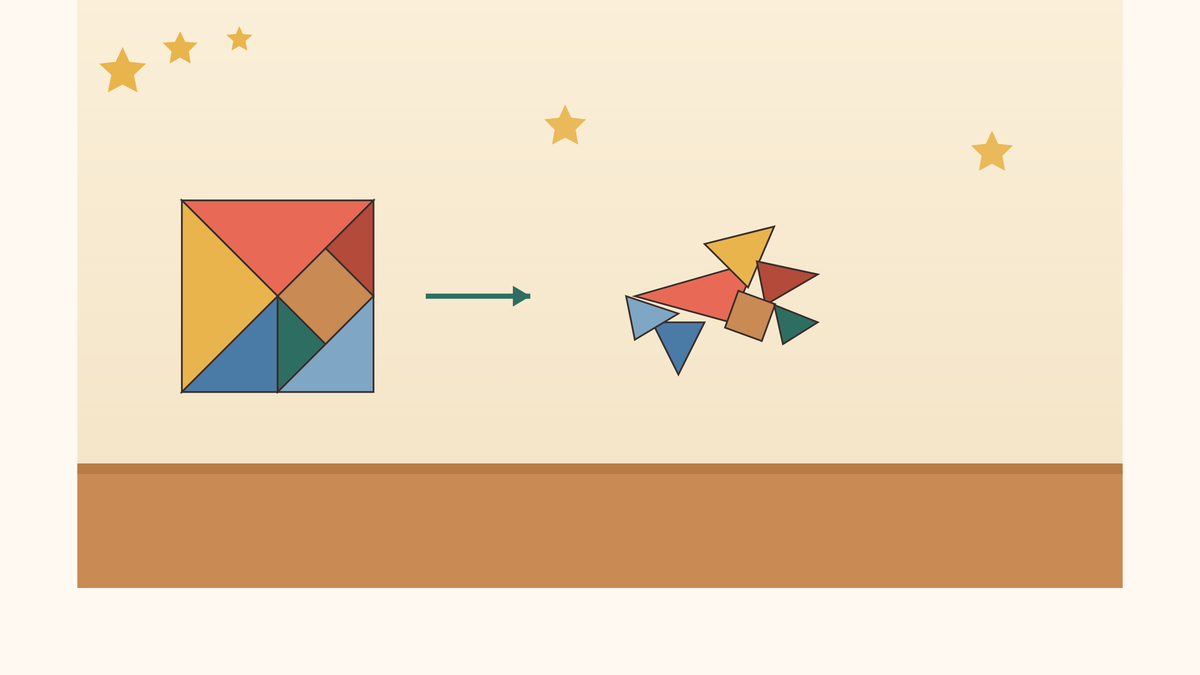
The Shape-Shifter Challenge — seven pieces, endless shapes
Tara had a question, of course. She always did. She was holding the Genie’s old brass puzzle — seven flat pieces that had spilled from a wooden box: two big triangles, one medium, two small, a square, and a slanty one shaped like a leaning table.
“These seven pieces,” she said, turning them over. “They don’t look like anything.”
“Ah,” said the Genie. “That’s their secret. They’re not one thing. They’re whatever the day needs them to be.” He arranged them into a sailing boat. Then, without adding or removing a single piece, a bird. Then a house.
“Same seven pieces,” said Anish quietly. “Every time.” “Same seven pieces,” agreed the Genie. “The pieces never change. Only how they fit the moment changes. Now — would the Gang like to try?”
(This puzzle is a tangram: seven pieces that never change, rearranged to make every shape. You may flip and turn pieces, and every piece must be used — but pieces may never overlap.)
EXPLORER (age ~8): The Boat
Make a simple sailing boat: a wide triangle hull below, a tall triangle sail above. Hint: start with the two biggest triangles — one lies flat for the hull, one stands tall for the sail; the rest fill the gaps.
VOYAGER (age ~10): The Bird
Make a bird in flight: a body, a pointed beak, two wings spread wide. Hint: the square makes a fine body; think about which pieces are shaped most like wings — and remember, a piece is allowed to turn.
CHAMPION (age ~12): The House with a Chimney
Make a house: a square base, a triangle roof, and a small chimney poking up. Hint: this one has a trick. Most people build the chimney last and run out of pieces. Try placing the chimney’s little triangle first, then build the roof around it.
Answer key — the reasoning, not just the picture
- Boat: the two large triangles do the heavy lifting — hull flat, sail upright — small pieces tuck into the gaps. Lesson: find the biggest, most important pieces first, then let the small ones fit around them.
- Bird: the square becomes the body only once you stop expecting it to be a “square.” Lesson: the pieces that seem to have one obvious job are often the most flexible — if you let them turn.
- House with chimney: building big-to-small runs you out of room for the chimney. Placing the tiny chimney-triangle first changes everything. Lesson: when a plan keeps running out of room at the end, the fix is usually at the beginning — a small change up front, not a bigger push at the finish.
Two things to wonder about
- The pieces never changed — only how they fit together did. Where in real life do you keep the same “pieces” (your time, your things, your friends) but rearrange them to fit a new day?
- Which shape was hardest? Was it hard because of the pieces, or because of the order you tried them in?
For the grown-up by your side
A tangram is adaptability you can hold in your hands — the same seven pieces meeting three challenges, unchanged, simply rearranged. If your child gets stuck, resist solving it for them; instead ask, “what if you started with a different piece?” That single question — trying a new starting point rather than pushing harder — is the whole Way of Life in miniature.