Aarav and the Wobbly Stage
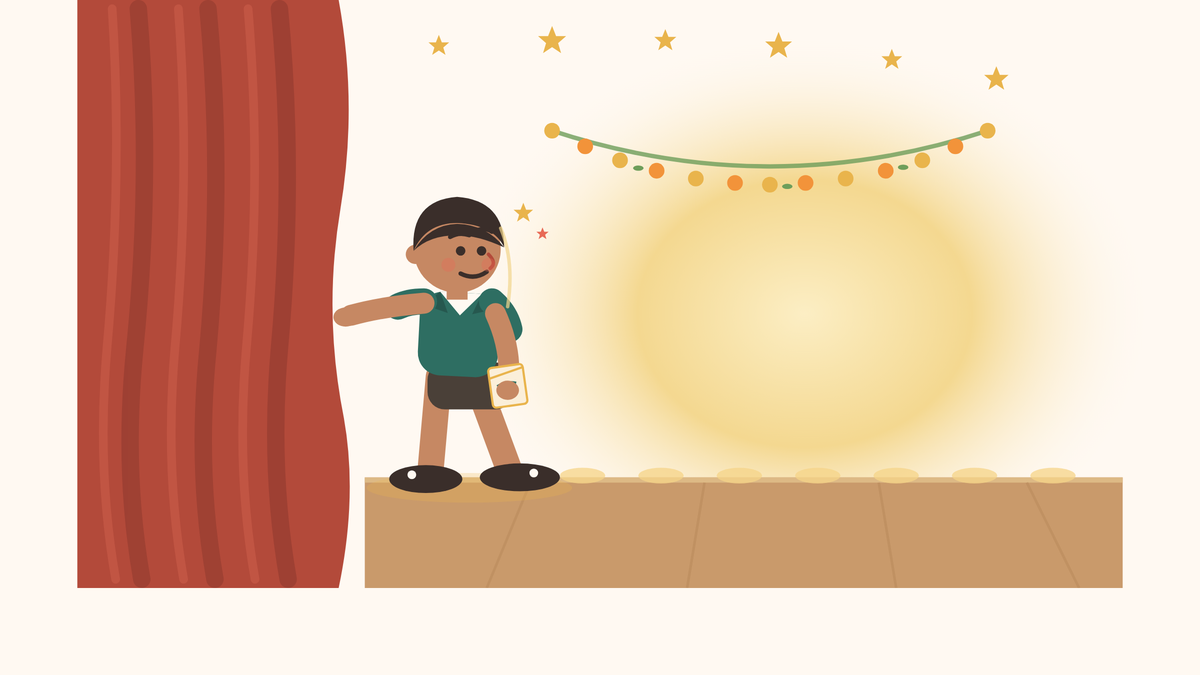
The stage lights were still switched off, but Aarav’s knees had already begun their own little performance.
Tap-tap. He touched his pencil twice against his palm, the way he always did before anything big. It did not help. In four minutes he would walk out in front of the whole school and recite a poem he knew backwards, forwards, and in his sleep — and right now he could not remember a single word of it. His mouth felt like the inside of a chalk box.
“You’ve gone a funny colour,” said Anish, appearing at his elbow the quiet way Anish always did, with a small folded paper square in his hand. He pressed it into Aarav’s palm. “For emergencies.”
Aarav unfolded it. Four short lines, in Anish’s careful handwriting.
- Name it.
- Shrink it.
- Practise it.
- Step forward.
“It’s a plan,” Anish said, and shrugged, as if plans were the most ordinary things in the world. Then he slipped back into the wings, because that was about as many words as Anish liked to spend at once.
Aarav looked at line one. Name it. All right, then. He shut his eyes and said the true thing, silently: I am scared everyone will laugh if I forget. And the strangest thing happened — naming the fear made it smaller. Not gone. Just a size he could see. A thing standing outside him, instead of a fog swirling inside him.
Shrink it. The whole school felt enormous. But he did not have to recite to the whole school, did he? He only had to recite to one row. So he picked the front row in his mind and let all the other faces go soft and blurry, like the edges of one of his maps. One row. He could talk to one row.
Practise it. His lips moved. The first line came — then the second — then the whole first verse, whispered so softly that only the marigolds in the decoration could hear. His voice was there after all. It had only been hiding behind his heartbeat.
Step forward. That was the hard one. There is no clever trick for the last step. You simply have to lift your foot.
“Aarav!” The teacher was waving him on. The lights came up, gold and warm.
Here is the thing nobody tells you: his knees were still wobbling as he walked out. The plan had not made the fear vanish. But somewhere between the wings and the microphone, Aarav understood something that would stay with him far longer than any poem. Being brave was not the same as not being scared. Being brave was doing the walk with the wobble still in it.
He found his one row. He took a breath. And he began.
Afterwards — after the clapping, after Khushi’s ear-splitting whistle from somewhere near the back — Anish met him at the steps.
“You forgot line six,” said Anish.
“I know,” said Aarav.
“Nobody noticed.”
“I know that too, now.” Aarav grinned and held out the paper square. “Keep it. I think Tara might need it next week.”
Because that was the real discovery, and it felt like finding a fresh path on the treasure map of himself: courage was not something you were born with, like the colour of your eyes. It was something you could build — one small step at a time. Which meant anyone at all could be a Kindness Champion of their own wobbling knees. Even you. Especially you.
❖ Have you ever felt your knees wobble before something big?
❖ Which of Anish’s four steps do you think you’d reach for first — and why that one?
Moral of the Story: Brave isn’t the absence of the wobble. It’s taking the step while you wobble.
For the grown-up by your side
Stage-fright is one of the most universal flutters there is — grown-ups feel it before a meeting or a difficult phone call just as children feel it before a stage. You might name a time it caught you, and the one small step that helped you walk on anyway. Naming it aloud quietly teaches that courage is built, not born.