One and One Make Eleven — Part 2
The evening after the two walls, there was a war.
It began, as these wars do, over origami paper. Khushi had taken three sheets of Anish’s good gold paper without asking (“I NEEDED gold, it’s for the moon”), and Anish, in return, had reorganised her entire shelf without asking, so that Khushi could no longer find a single thing in the beautiful chaos she called a system. There was shouting. There was a slammed cupboard. There was a declaration, from Khushi, that she would never speak to Anish again as long as she lived.
Then Mom called, “Khaana lag gaya,” and dinner was served, and — as always in that house — the war did not survive the meal.
It’s a strange thing about that family: their quarrels never outlived a plate of food. By the time Mom’s dal reached the table, Khushi was telling Anish about the number-nine rangoli disaster, and Anish, without a word, had slid the least-spicy piece of aloo onto her plate — which was the closest he ever came to saying sorry. Khushi, without a word, put the gold paper back beside his pillow that night, folded into a lopsided star.
Neither of them mentioned the walk. But something had loosened.
The next morning, small things came back — quietly, the way small things do.
Before they left, Anish did something he hadn’t done in weeks. He tore a small strip of paper, wrote on it in his careful letters, and — while Khushi was busy losing one shoe — slipped it into the front pocket of her school bag where she’d be sure to find it.
Khushi found it in the middle of art period, of all times — right in the fizzing, waiting hour. She unfolded it under the desk. It said:
1 + 1 = 2.
But look —
1 beside 1 = 11.
Standing next to each other, we’re bigger.
Khushi read it four times. And the strangest thing happened: the fizzing settled. Not because her turn had come — it hadn’t — but because someone had reached across the whole morning and caught her idea before it went flat, exactly the way he always used to. She wasn’t alone in the waiting anymore. She could feel him there, one strip of paper wide.
She waited. And — for the first time in her whole waiting life — she waited well. When her turn finally came, her rangoli idea was still bright, still every-colour, still hers.
At her own lunch, alone, Anish opened his tiffin and found something that didn’t belong there: a tiny gold star, lopsided, folded from his own good paper, tucked between the roti and the lid. No note. None needed. He knew exactly who, and exactly what it meant. He smiled at it — a real one, all by himself, in a room full of other boys who had no idea a whole conversation had just happened inside a tiffin box.
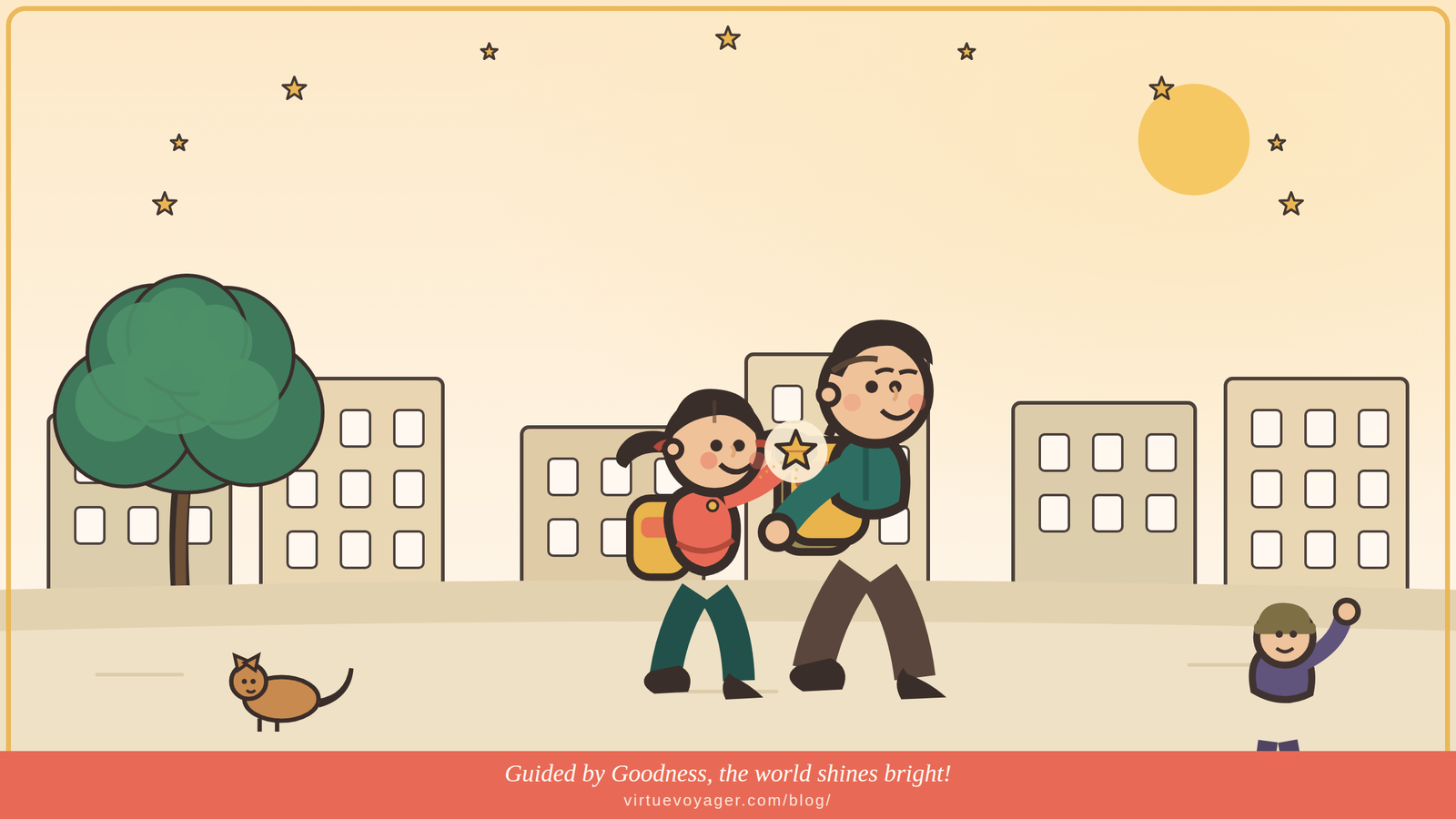
That afternoon, at the gate, Anish did the thing that changed everything without a single word being spoken about it. Instead of striding off ahead, he waited. Bag on one shoulder, eyes on the school door, until a small tornado in pigtails came barrelling out — and then he reached over and took her heavy bag onto his shoulder, the way he used to, the way he’d stopped.
And it was Riya, of all people, walking out beside Khushi, who said it out loud. “Look,” she told her friend, watching the tall boy shoulder the little one’s bag, “look how those two look after each other.” She didn’t know she’d said the truest thing all day.
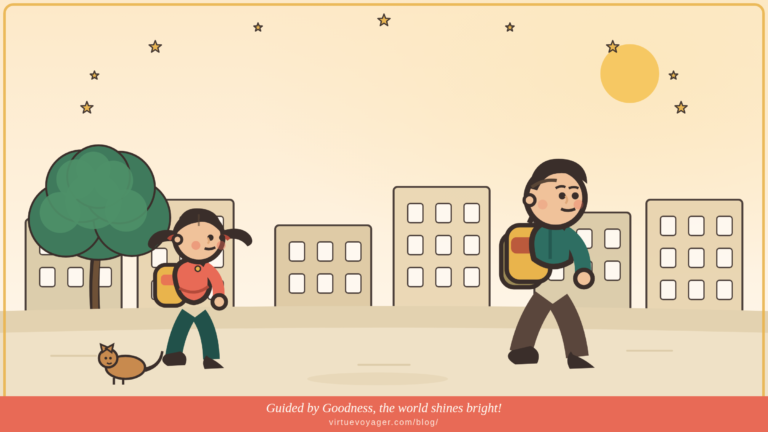
That Friday, they walked to school together on purpose.
It was Khushi’s plan — “at LEAST one day a week, that’s the rule, I’ve decided” — and Anish, who loved a rule, agreed. So there they went, shoulder to elbow, past the courtyard cat and the waving watchman, Khushi humming her mango-moon song wrong and Anish knowing every wrong word.
And here is the thing the old Anish could never have done. At the school gate — the very gate where a boy had once laughed, “You bring your little sister everywhere?” — Anish did not speed up, and he did not let go. Side by side with Khushi, her small shoulder at his elbow, he walked in through it in full view of the whole morning crowd of children. Some of them looked. Let them look. He was not walking a little sister past the gate anymore — he was walking in beside the bravest person he knew, and he wanted the whole school to see it. The small stone that had sat in his shoe for weeks simply fell out. Khushi matched him step for step, chin up, humming, as if it were the most ordinary and most wonderful thing in the world.
Here is the surprising part. That was the very day Anish’s hand finally went up.
When the teacher pointed again at a number on the board, and it was wrong again, Anish felt the old stone in his shoe. But this time he could still feel the morning walk in his shoulders — the small tornado had been right beside him not an hour ago, hands-on-hips brave, and would be beside him again by evening. He borrowed a little of that. He didn’t have to be as loud as her. He only had to be as sure. His hand rose. His voice, small but steady, said, “I think there’s a mistake. I made a chart.” And he unfolded it. The teacher looked, and blinked, and said, “You’re quite right, Anish.” The number was fixed. The splinter came out.
I did it, he thought — and then, honestly: We did it.
Two doors down, Khushi was told number seven, please wait — and she remembered a strip of paper one strip wide, and a brother who caught her ideas so they never went flat, and she waited, and it did not hurt, because a person who is loved from across a corridor is never really waiting alone.
Standing beside each other in the morning had given each of them the courage to stand up in their own classroom. That is a kind of magic no one can see and everyone can feel.
That night, Khushi added a smile to her finger-count that she couldn’t quite explain — not the quick, poppy kind that fizzes and is gone, but the warm, settled kind that stays in your chest like a blanket long after. Blanket Happiness, the Gang would call it. The kind you can’t buy and can’t rush and can only grow, side by side, with someone who was there all along.
Moral of the story: two ones standing apart make only two — but two ones standing side by side make eleven; togetherness is a strength you can’t add up any other way.
Two things to carry with you: who is the quiet teammate life already gave you — the one whose nearness makes you braver, whom you might have started walking past? And what is one small, wordless kindness you could slip back to them this week, no announcement needed?
2. Grown-up note
For the grown-up by your side: The turn in this story isn’t a talk or a rule handed down — it’s a folded paper note found alone, a bag lifted at the gate. This week, you might simply watch for one such small signal already passing between the children (or the grown-ups) in your home, and let it be noticed rather than corrected. Sometimes the kindest thing we can do for a bond is see it.
“Guided by Goodness, the world shines bright!” — Virtue Voyager